Understanding SECURE ESOP Plans
The SECURE Act of 2019 and SECURE 2.0 of 2022 both aimed to increase retirement savings in the U.S. and both have provisions that have impacted several areas of the retirement plan industry. One of the new provisions that was effective in 2021 impacted newly established employee stock ownership plans (ESOPs) by allowing for additional short-term tax benefits. Specifically, the SECURE Act granted businesses permission to treat qualified retirement plans, adopted before the extended corporate tax return due date, as having been adopted on the last day of the taxable year.
A company establishing a new ESOP that takes advantage of this provision in the tax code is said to establish a SECURE plan or a “retro” plan. A SECURE plan is created in what is technically the second plan year via a transaction between the trustee and the company. For example, if your ESOP transaction occurs in August 2026, historically, that meant your first plan year would be January 1 to December 31, 2026 (for a calendar year plan). The SECURE Act allows you to treat the ESOP as having been adopted on December 31, 2025, which entitles the company to a deduction on its 2025 tax return.
There are several nuances with SECURE plans and below we will cover reasons to establish a SECURE plan, as well as plan design, timing, and testing considerations.
Key Reasons to Establish a SECURE Plan
Added Flexibility
Historically, there was a mad rush each December to finalize plan documents, hunt down signatures, and close ESOP transactions prior to year end. With the allowance of retroactive adoptions, everyone can breathe a little easier. ESOP sponsors now have until the extended due date of their corporate tax return to adopt a new plan. This allows time to dive deep into plan design, negotiate specifics of the transaction, and consider employee communication strategies.
Additional IRC Section 404(a)(3) Tax Deduction
The 404 contribution limit is often simplified to suggest that the deduction limit for a plan year is 25% of eligible compensation. However, the actual regulations can be more complicated in practice. We have a separate article that dives deeper into the analysis for the tax deduction limitations, but to simplify, the significance for a SECURE plan is allowing an additional year of deductible contributions.
Plan Design Considerations
Plan and Allocation Eligibility
More eligible employees can mean higher eligible compensation which can lead to a larger maximum deductible contribution. Therefore, more inclusive plan entry provisions are common for SECURE plans, often including any employees over the age of 18 to be retroactively eligible for plan entry if they are employed at the end of the retro plan year. For example, if the transaction closed in April 2026 and the retro year is January 1, 2025 – December 31, 2025, anyone actively employed on December 31, 2025 and at least age 18 may be allowed to enter the plan in 2025. The plan sponsor may also elect to give contributions to everyone employed on December 31, 2025, and not require 1,000 hours of service during the year. This approach allows the plan sponsor to truly maximize their 404(a)(3) deduction for the retro year. The employee ownership message shared during the kick-off meeting (likely in the summer of 2026 in the example above) could also impact a greater percentage of the active employee pool.
DDR Allocation Eligibility Exclusion
ESOPs commonly require participants to work at least 1,000 hours and be employed as of the last day of the plan year to be eligible for a contribution. Many plans waive these requirements for participants who leave the company due to either death, disability, or retirement (DDR), meaning that DDR participants do not need to meet an hours requirement or be employed on the last day of the plan year to receive their portion of that year’s allocation. When an ESOP starts with a retro year, it is best not to waive these requirements for DDR for the retro year.
The reason for this is due to the timing of the transaction and the retro year contribution. If a participant receives a DDR cash contribution for the retro year, they are also likely 100% vested due to their DDR status, and eligible for a distribution in the second plan year. Assuming these participants would be eligible to receive the cash value of their contribution as a distribution, that cash cannot be used during the transaction (to purchase shares or make a loan payment). Since the allocation often is not completed until after the transaction, it’s difficult to get an estimate of the cash that must be “held back.”
The ESOP industry is still working through establishing best practices for retroactively adopted ESOPs, and in some cases, still awaiting further regulatory guidance. However, we have already had an opportunity to learn what works well – and what doesn’t!
Testing Considerations
IRC Section 415(c) Annual Additional Limits
The annual additions limit for each participant is the lesser of 100% of their gross compensation or $72,000 (for 2026). All contributions and reallocated forfeitures made to defined contribution plans by both the participant and the employer must stay at or below this limit each year. This limit is more often violated when there are multiple plans involved, and a large ESOP contribution is made.
Most plan documents are written such that the annual additions value of shares released from suspense is the lesser of the fair market value of the shares or the contribution used for ESOP loan payments. However, there is no share release in the retro year because the transaction did not occur until the following plan year. Therefore, the annual additions are equal to the contributions made to the plan. If a company is maximizing their contribution under 404(a)(3), there will be participants whose combined ESOP and 401(k) contributions (which includes employee deferrals) exceed the 415 limit.
The plan document will dictate how the excess contributions are handled, and the correction method must align between plans, if multiple plans exist. If that is the case, keep in mind that amending the 415 cutback provisions in the other plan the company sponsors is not going to be an option for the initial plan year for the ESOP given the retroactive timing. The correction could result in either returned 401(k) deferrals and/or forfeited associated matching contributions for the retro year, or a reduced contribution for that participant in the ESOP. If you have already processed ADP or ACP refunds in your 401(k) plan for the retro year, make sure to mention this to your attorney and consultant, as this has a significant impact on calculating and processing refunds. Regardless of the correction method, proactive communication with impacted participants is key to avoid confused or upset employees.
Timing Considerations
Participant Statement Timing
As qualified retirement plans, ESOPs are required to provide participants with an account statement on an annual basis. However, this can be a challenge with the SECURE plans for two reasons. First, is the timing.
With an ESOP transaction able to close as late as October 15th of the second plan year, it is often unrealistic to complete the plan administration of the retro year before the third plan year begins.
Another challenge that a retro year presents is what is displayed on a retro year ESOP participant statement. As mentioned above, there are no shares in the ESOP during the retro year because the transaction hasn’t yet occurred. The ESOP only holds an accrued cash contribution. This cash contribution is then used during the transaction to either make a loan payment or purchase shares. The post-closing value of those shares is significantly lower than the cash contribution amount due to the debt the company took on for the transaction. For example, a $3,000,000 contribution may purchase $3,000,000 of shares, but the value of those shares after the transaction might only be $50,000. Assuming the initial contribution is used as a loan payment in year two, a participant who received a $50,000 cash contribution for the retro year would only have share value equal to $833.33 in their account in year two. Rather than start things off on the wrong foot with participants, most plan sponsors opt to combine the retro year and second year information into one combined statement.
Form 5500 Filing
All plan sponsors of an employee benefit plan subject to ERISA must file Form 5500 each year. The extended deadline is the 15th day of the 10th month after the plan year ends (October 15 for December 31 plan year ends). This poses a wrinkle for the retro year – how can Form 5500 be filed by October 15 if the plan sponsor has until that same October 15 to adopt the plan? Luckily, the IRS has provided relief on the initial filing. The first filing is not due until the filing deadline (plus extension, if filed) for the second plan year. This filing will contain information on the retro and second plan years. No separate filing is needed for the retro plan year.
Post-Closing Adjustments
Regardless of when the ESOP transaction closes, post-closing adjustments may be made to the deal, anywhere from 60 to 180 days after the close date. This impacts the final purchase price and thus the total value of the internal ESOP note, which is used to calculate the amortization schedule, the required annual loan payments, and eventually the resulting shares released to participants. Proactively communicating this adjustment with your Blue Ridge team is important to avoid future plan rework.
Administrative Timeline
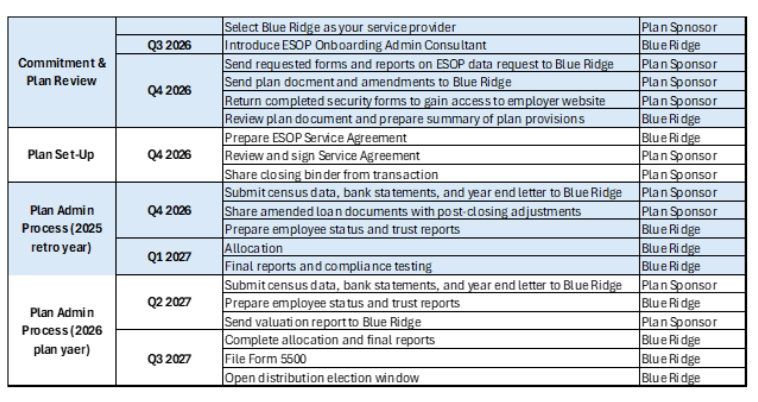
An administrative timeline is established for each plan year for the ESOP and covers everything from the data collection process through sharing updated participant statements with updated balances. With SECURE plans, the first two years of the ESOP administration process (aka record keeping) is slightly different.
One key reason for the difference is that the first Form 5500 and participant statements created cover the first two years of the plan; whereas usually, these items are required on an annual basis for all qualified retirement plans. Below is a snapshot of a sample administrative timeline for a retroactively established plan with an ESOP transaction that closes in 2026 before the 2025 corporate tax filing extended deadline:
Conclusion
A SECURE plan refers to an ESOP that completed the transaction to create the plan in what is technically the second plan year. This is a relatively new plan creation design in the retirement plan industry and some of the nuances are not yet fully evaluated by the IRS and DOL. Like many other areas of the retirement industry, communication with your team of advisors as well as plan participants is imperative to help ensure a successful implementation of the ESOP, which includes understanding compliance requirements, plan sponsor expectations, and the overall administration timeline.
If you want to discuss any of the above topics in more detail and better understand how they apply to your situation, contact a member of your ESOP team at Blue Ridge – we are here to help.